AI Healthcare Solutions at Harmony Healthcare: Tyler Maister
Harmony Healthcare provides healthcare organizations with the talent and resources needed to succeed today as well as the foresight to prepare for tomorrow’s challenges.
In this employee spotlight, we’re excited to highlight Tyler Maister, Director of Data Solutions at Harmony Healthcare. We spoke with Tyler to share his advice for clients, as well as insights from his career journey.
1. Tell us more about your role at Harmony and the work you do.
As the Director of Data Solutions, I lead the strategy and execution for the development of our product lines, analytics, and reporting for our clients. My day-to-day work involves building AI-enabled products to enhance our consultants and building client-facing dashboards and analytics tools that help our hospital partners measure and track goals. I work closely with our Clinical Documentation Improvement (CDI) specialists, medical coders, and auditors to translate the incredible work they do into measurable outcomes our clients can see and act on.
Right now, one of the most exciting things on my plate is developing new applications that will allow us to offer an entirely new data service to our clients. It’s a big shift from where we started, and it’s going to fundamentally change the way we deliver value to the health systems we serve.
2. What are you most proud of about your journey with Harmony Healthcare?
I started at Harmony as a recruiter and spent five and a half years in that role before transitioning into data analytics. I’m most proud of building this function from the ground up. When I moved into the data side, there wasn’t a formal analytics team or toolset in place for what we do now. I saw an opportunity to bring more rigor and visibility to the outcomes our teams were driving, and leadership gave me the room to run with it.
Going from recruiting to owning the entire data solutions function and now leading a major platform implementation is something I never could have mapped out on paper. But Harmony gave me the opportunity to grow into it, and I’m proud that the work we’ve built is now a real differentiator in how we serve our clients.
3. What is the biggest takeaway you’ve gained from your career thus far?
Don’t wait for someone to hand you the perfect next step. My career pivot didn’t happen because a role opened on a job board. It happened because I saw a gap, taught myself the skills to fill it, and then made the case for why it mattered. The willingness to be uncomfortable and learn something new, whether that’s Python, TypeScript, healthcare data models, or how to architect a platform, has been the single biggest driver of my growth. Curiosity and initiative will take you further than any credential alone.
4. What are emerging trends that you think people in the industry need to be prepared for?
The biggest trend is the convergence of AI and clinical data. We’re already seeing how advanced analytics can surface Hierarchical Condition Categories (HCC) opportunities, identify documentation gaps, and predict risk adjustment impact at a scale that wasn’t possible a few years ago. Healthcare organizations that aren’t investing in their data infrastructure will fall behind quickly.
For our industry specifically, the shift from volume-based to value-based care is making accurate documentation and coding more critical than ever. The organizations and consultants who can prove their impact with data are the ones who will thrive.
5. What advice would you give professionals about embracing new technology in healthcare?
Start with the problem, not the technology. It’s easy to get caught up in the buzz around AI, machine learning, or whatever the latest platform is. But the real question is always: what problems are you solving for the people doing the work? The best implementations I’ve seen are those where someone deeply understood the clinical or operational workflow first, then found the right tool to improve it.
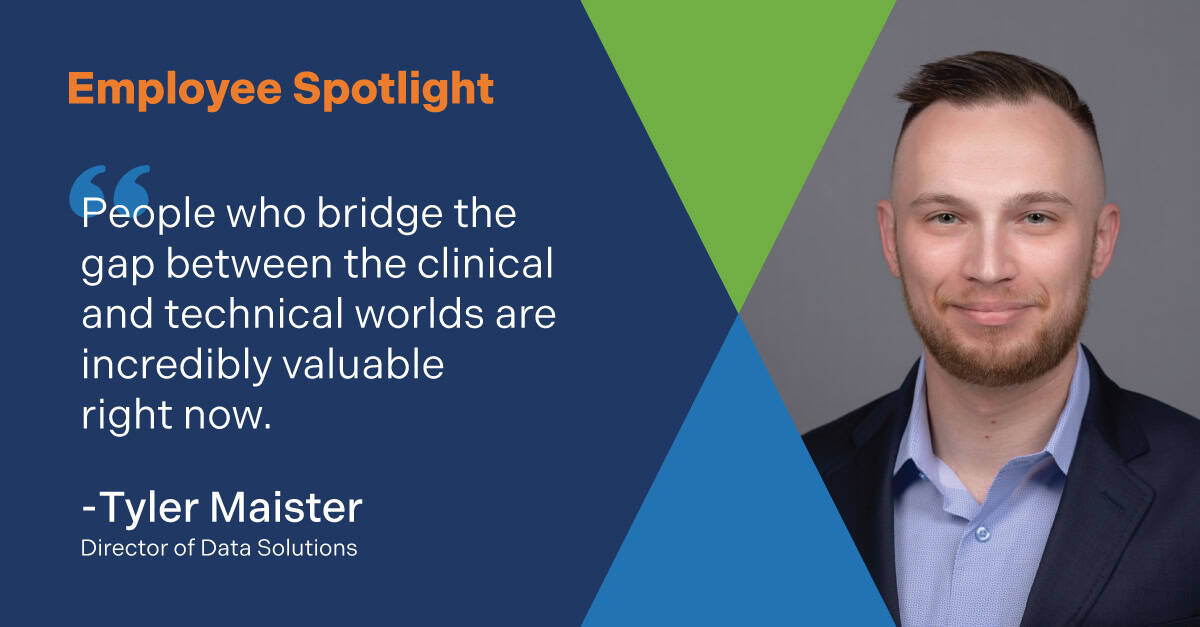
My other piece of advice is just to get your hands dirty. You don’t need to become a software engineer, but having a basic understanding of how data flows, what an Application Programming Interface (API) does, or how a dashboard is built will make you infinitely more effective in your role, no matter what that role is. People who bridge the gap between the clinical and technical worlds are incredibly valuable right now.
6. Tell us a little about Tyler outside of your professional life.
Outside of work, you’ll probably find me in the gym, kitchen, or on the golf course. I love cooking, and I’m always experimenting with new recipes — it’s become a real creative outlet for me. I’m also big into strength training and have picked up golf recently. Although the improvement has been slow, I’m enjoying the process.
7. What’s a fun fact about Tyler that most people don’t know?
Once, I tried to build a machine learning model to predict MLB game outcomes. I went deep into historical stats, feature engineering, and testing different algorithms. I can’t say it made me rich in my fantasy league, but it accelerated my interest in data science and taught me more about Python than any course ever could. Most people at work just know me as the data guy, but the origin story involves a lot of baseball stats and late nights tinkering with code.
8. Anything else you’d like to say?
I’d just encourage anyone reading this who’s thinking about making a career change or picking up a new skill. It doesn’t have to be a dramatic leap. For me, it was one Excel formula, then one dashboard, then one client presentation that went well, and it snowballed from there. Harmony has been an incredible place to grow because the culture genuinely supports people who are willing to raise their hand and try something new. If you’re curious about something, chase it. The worst that could happen is you learn something new.
Whether you’re looking to enhance your organization’s operations with talent with AI experience or are looking for a new role, Harmony Healthcare can help. Reach out to us to see how we can support you.